
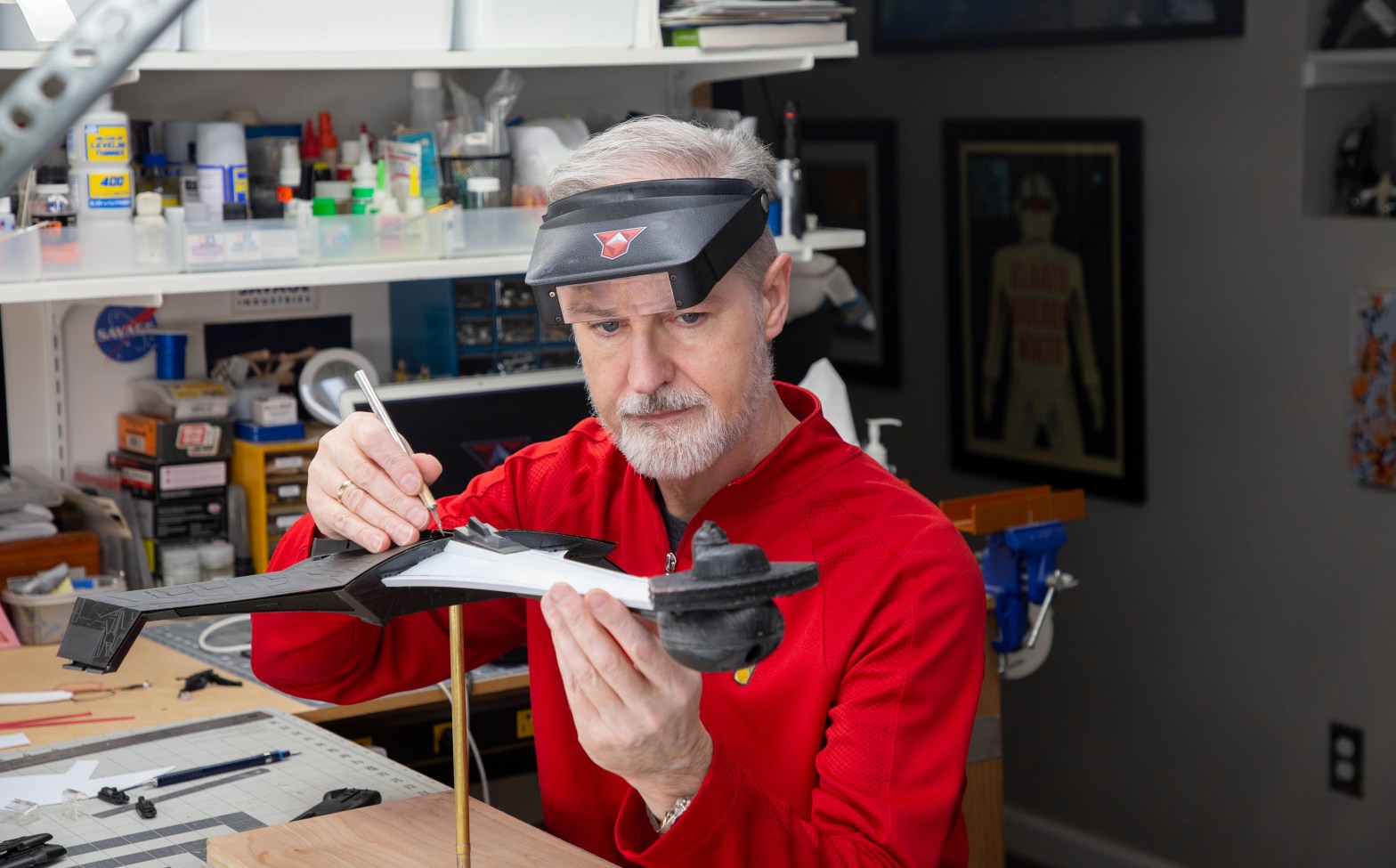
Before we dive in, a note: today’s post shifts toward model-building and sci-fi—in particular, the ever-expanding world of Star Trek, another interest of mine. It’s a different kind of creativity, but still one that reaches for something beyond ourselves: vision, story, and beauty that stirs the imagination.
I grew up seeing Star Trek starships as imaginary vehicles that carried me into danger, adventure, and wonder—beyond anything I could dream up on my own. They weren’t just spacecraft; they were story machines. And that impulse to imagine and create hasn’t left me. Even at 60, I don’t think I’ll ever let It go.
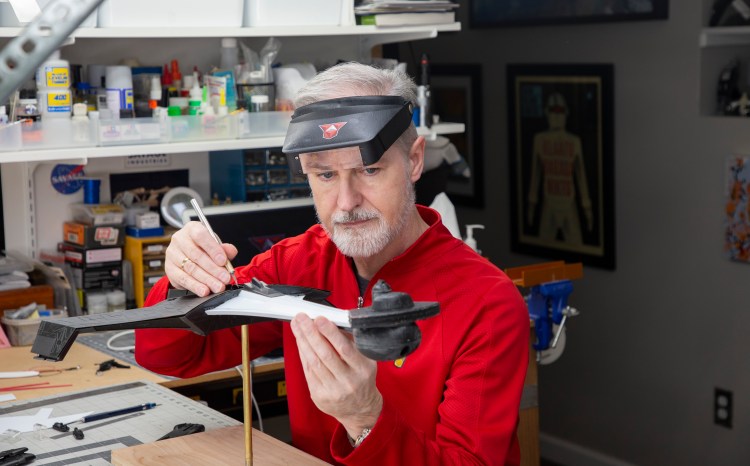
Bill Krause understands that drive. Many know his name from the model-building world, or from his contributions to the visual universe of Star Trek. Bill built the USS Titan-A (that became the Enterprise-G) in Star Trek: Picard, Season 3. His models have also appeared in the much-adored Star Trek Ships of the Line calendars, and his original starship designs have circulated widely among Trek fans who appreciate thoughtful world-building, convincing lines, and practical detailing.
But that’s just the surface.
In early June of 2022, I made my first-ever trip to what model-building fans might call a pilgrimage site: WonderFest in Louisville, Kentucky. It is part sci-fi convention, part builders’ showcase, and part reunion of like-minded artists. Bill was there as a featured guest. His Stargazer starship was creating quite the buzz among attendees. We were introduced by mutual friend and no stranger to Wonderfest himself, L. M. Oliver (Renaissance Man extraordinaire.)
Egos can blister the sky at Wonderfest, but Bill was unexpected: a soft-spoken guy who puts his figurative Spock ears on one at a time, just like the rest of geeks…despite a talent that deserves a 21-phaser salute.
Bill had already been designing and building starships for over a decade. What makes them unique is his approach: he favors the in-universe design aesthetics between the Original Series (TOS) and the first Star Trek movie.
His work took a public leap when this fan-built Stargazer — a retro TOS-era take on the ship first seen in The Next Generation (TNG) — was chosen by Star Trek: Picard’s production team as the basis for their up-dated on-screen version in Season 2.
In addition to having a backstage look at his Stargazer, I also got to see the Javelin shuttle (companion to his USS Sentinel) in all its lighted and deployed glory, a stunning piece of practical modeling. More on that later.
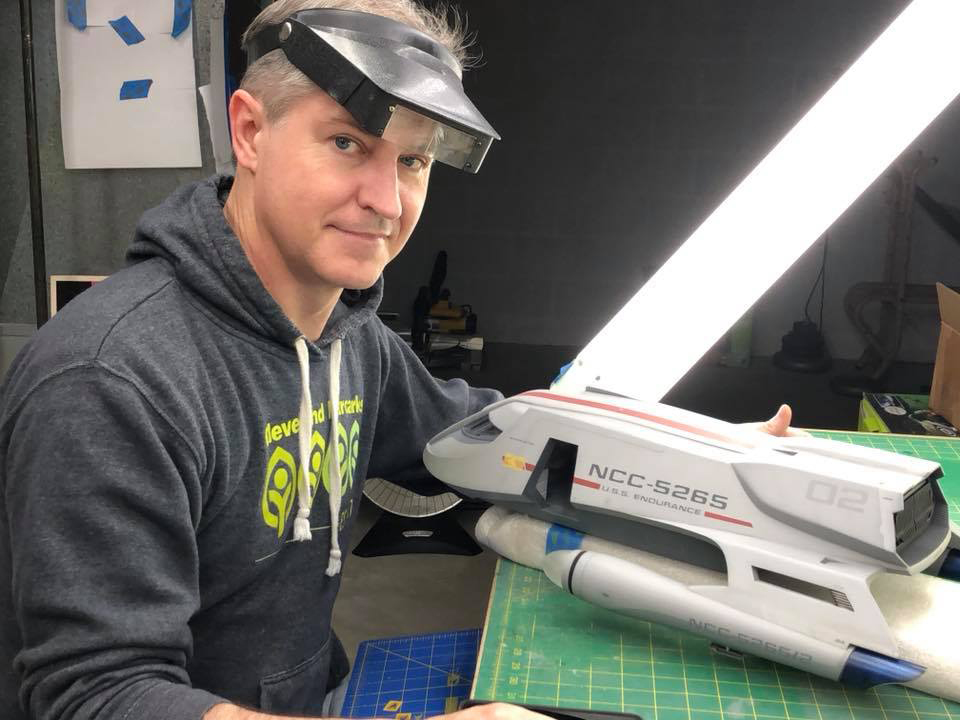
I asked Bill to indulge me with a brief Q&A and what follows are insights into his physical craft, design philosophy, storytelling, and how it feels to see his creations go from desktop to Star Trek canon.
Q&A WITH BILL KRAUSE
Model Builder and Starship Designer
The Physical Craft
What keeps you working with physical models, especially now that so much has gone digital?
I like to use my hands to craft and create things. I also like to see my designs realized in the physical world. I use digital software to finalize concepts that start as sketches, then turn them into 3D models often printed as parts. Having worked in media production through many changing formats, it’s nice to have something real, tangible, on a shelf for anyone to see.
Can you think of a moment when working with real materials gave you something digital tools never could?
Creating organic shapes is hard in 3D software, and I’m not a skilled 3D modeler anyway. I prefer the tactile feel of shaping these complex forms by hand—like automotive designers using clay. But for precise geometric patterns, 3D is unbeatable.
From Fan Builds to Canon Work
What went through your mind the first time one of your ships showed up onscreen in Picard?
I’d worked with the art and visual effects teams for months, so I knew what to expect. The first onscreen ships were gold-plated ready-room props I built for the Stargazer set in Season Two. It was a year after I made them, and I was thrilled but had to keep quiet due to the non-disclosure agreement. The gold models showed for about a second, behind Jeri Ryan’s head in the dark, but I knew they were there.
Season 3 was different. The gold Titan models appeared in almost every episode behind the actors. It was surreal seeing my work next to Patrick Stewart.
Did your design process shift at all once your builds became part of canon?
Not really. Many designs were based on prior work. Developing the Duderstadt1 for Season 3 was unique since I had to envision a 25th-century starship with limited references—just John Eaves’s Inquiry-class from Season 1. Terry Matalas2 liked an updated TOS-era Chaparral-class predecessor of the Hornet and asked for angled nacelles, which were dropped in the final. Since then, my design work continues with the goal of expanding an unseen ship universe.
Balancing Legacy and Innovation
When you’re designing, how often do legendary Star Trek design folks like Matt Jefferies, Andrew Probert, Rick Sternbach, John Eaves, or Doug Drexler cross your mind?
Every single second. That is the bedrock. They set the benchmark for the canon eras in which I’m designing new ships to fit into or in-between while adding some of my creative license and design style.
How do you walk the line between keeping something new and making it feel like it belongs in Trek’s visual world?
This is the $64,000 question. It’s a narrow path, which is unfortunate. I find “you’re damned if you do and damned if you don’t” do something different when it comes to fan expectation and acceptance. What makes a Star Trek ship a Star Trek ship? They all have to look like the Enterprise—a saucer with a connecting neck to a secondary hull and two cylindrical nacelles. That’s it. Or, “Oh, that looks just like the love-child of X and Y ships.” So, I try to ignore all of that as much as I can and build things that appeal to me and maybe expand the design language a little bit. Exploring strange new hull shapes and new nacelles. You know, boldly going like we’re supposed to do. As I get older, I’m less worried about walking that line and am all about machete-carving new directions. Part of that comes from not seeing onscreen what I want to see—more starships. If they’re not going to give them to us, I’m just going to make my own.
Ironic; that’s the kind of thinking that resulted in Star Wars (1977)! Were there any choices on the Titan-A or Stargazer that pushed you into new territory?
With the Titan-A, they just took the Shangri-La and had me do a mock-up with their new 25th-century nacelles so there was nothing for me to do beyond that. Although I did spend a week sketching out ideas to revamp the entire ship into a more 25th-century aesthetic with the expectation that there would be more development time or design feedback, but that never happened or was asked for.
With the Stargazer, production designer Dave Blass had originally asked me to build ready-room models of the new Sagan as well as recreate Rick Sternbach’s TNG-era Constellation, and while I was at it, design and build a third TOS-era predecessor. There was no guideline or brief on what that was to look like. So I gave them six different concepts—some with four engines, some with two in all sorts of configurations and “Tycho/Bill Krause” style components to get a sense of what direction they wanted to go with the very first Stargazer. It also didn’t have to have four engines or look anything like the Constellation. It could have been a space-canoe. They chose the first concept and it had four engines in an X-wing configuration, so that was the first four-engine ship I got to design and build.
Storytelling in the Details
I’ve drawn Trek starships for years and loved to imagine the world in which they‘d exist. Why is ship backstory important to you, even if it never shows up on screen?
When you’re working on a particular design or model for as many months as I do, your mind will wander into those fictional aspects of its place in the Trek universe. It helps to make it real and feel a part of the collective narrative, at least to me. Often, when I publish finished work, others are also interested in the backstory—the classification, stats, role and mission—so they can add it to their head-canon. I try to make sure I have those answers as these ships seem to make their way into other’s fan-fiction, fan-films, or official canon—TV and gaming.
If you could slingshot around the sun and drop one of your ships into a specific moment in Trek history, where would you love to see it?
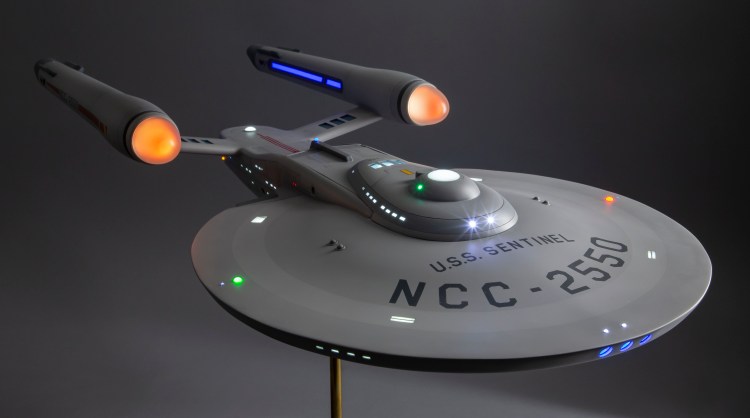
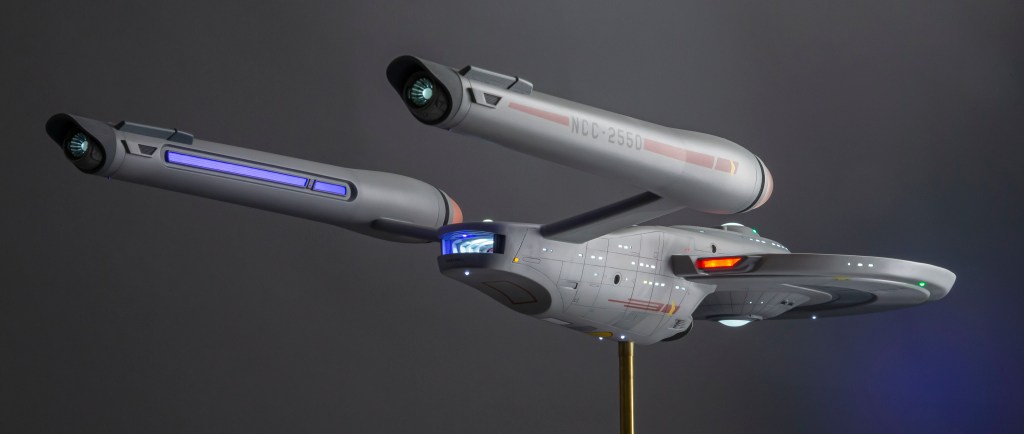
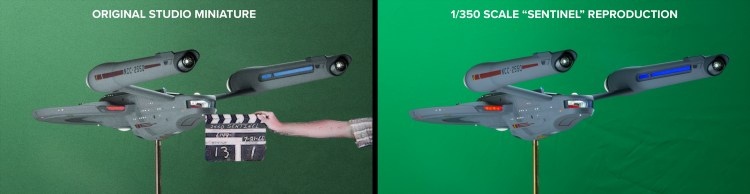
I had always dreamed of seeing the Sentinel as “some background ship” in the original TOS series. I mean, if I could have been working on the show back then and had this design ready to go to drop in as a guest ship, it could have been used as the Constellation in “Doomsday Machine,” or the Defiant in “Tholian Web,” or the Exeter in “Omega Glory.” Instead of reusing the only starship model over and over again, adding that variety was the whole reason why I started creating these in the first place.
Technical Ingenuity
Was there ever a build where something just wouldn’t cooperate, and you had to come up with a creative fix?
That’s really what happens in everything—it’s always a creative compromise when something never goes quite to plan. There’s an overall goal with each project: seeing the concept realized in physical form. There are several stages to each project—concept, design, 3D modeling, print, fabrication, electronics, assembly, paint, and markings. Much of this has been standardized, but I do like to push the envelope where I can and try new things, new materials, new tools, new processes to learn new things I can apply to the next project to keep it all interesting to me and hopefully get better as I go so it’s not all repetitive. So when a roadblock does occur, I like to have a toolbag of options and solutions and know what to avoid the next time.
Are there any little techniques or signature details you keep returning to over the years?
Some of my ship features have become standardized—at least for ships of the TOS era. Most notably is the navigation and beacon lighting which runs off of a single 5V Arduino Pro Mini—programmed with the sequence pattern I’ve come to prefer. I have triple strobes for the bow and stern, double for the dorsal and ventral, and single strobes for the port/starboard. On the design side, the conical Bussard collector is a streamlined version of the classic hemisphere and I’ve used that on all of them now with a rotating and backlit geodesic impeller inside. A subspace antenna fin is a standard feature with a soft fading blue beacon atop. The 35mm slide film inserts behind the window ports is another thing I love to do and adds that extra bit of realismcawhen peering close to the model. The decal registry markings are a version of the TMP style but without the red outline and are instead outlined in white. The ship plaques used on the base have been a consistent staple for over ten years with each one receiving their own unique class logo design.
Navigating Fan Feedback
The Titan-A reveal definitely got people talking. How do you take in fan responses, good or bad?
I’ve always appreciated the kind words of encouragement and as an art form, it’s of course subjective. I try to not take it personally but each ship carries a part of me so it’s been a challenge.
Has anything fans have said ever changed how you look at your own work?
If it’s productive. The ships I build, I really build for my own enjoyment. Not theirs. My hope is that maybe my ideas might inspire someone else who can take it the next step. I get inspiration from the examples of what others can create, not so much by what they say.
Looking Ahead
Are there any ship classes, factions, or Trek eras you haven’t built for but would like to?
There are so many! I feel like I need to develop some ship design variations of the Strange New Worlds-era as we’re unlikely to see much more than the 1701. Again. I have ideas for several dozen ships including Romulan and Klingon. There are a few small craft—shuttles and runabouts, as well as science and civilian cruise ships.
What kinds of projects are most exciting to you now? More screen work? More scratch builds? Something completely different?
All of the above! Really, creating new designs is the top for me. Be it scratch built or digitally crafted and printed. And it doesn’t have to fit a Trek universe. I have many ideas yet to explore.
A Modeler’s Moment
Do you have a favorite photo of one of your ships? Maybe something that tells its own little story?
I shot my Javelin shuttle in the backyard snow one day and composited with some Alpine background. There’s something about a spacecraft in a familiar looking environment that sparks believability and adventure.


I have a feeling this won’t be the last time Bill’s work gets noticed by Hollywood — or by the rest of us who love stories that look up, out, and beyond. Whether you’re a lifelong Trek fan or just someone who admires good craft, I hope you found something to appreciate in Bill’s journey. We’ll be keeping an eye on what launches from his Ohio workshop next.
You can find more about Bill’s work that is mentioned here at his Instagram and YouTube pages. See also the Memory Alpha entry about him.
Live long & prosper…erm, sorry…
That’s it for now. Thanks for showing up. It matters.

Photos by Bill Krause
References:
 Veni. Vidi. Scripsi.
One thought on “Beyond the Build: A Different Conversation with Bill Krause”
Comments are closed.