
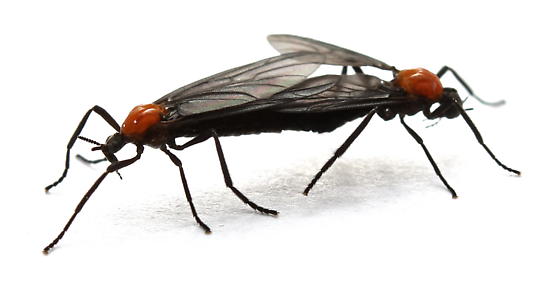
We’ve made the drive south to Lake Charles a few times over the past couple of weeks. And ran into an old nemesis… They’re everywhere, leave a nasty mess on your car, and smell like Charlie the Tuna’s gym socks from last month.
You guessed it: Love bugs!
If you’ve lived in southwest Louisiana long enough, you know the drill: spring and fall roll around, and suddenly the roads, cars, and windows are swarmed with tiny black bugs stuck together head-to-tail. Folks call them “love bugs,” and yes, they’re almost always in pairs. But what exactly are they, and why do they appear in such massive clouds?
Everything You Wanted to Know About Love Bugs (But Were Afraid to Ask)
Love bugs are the adults of a fly species called Plecia nearctica. This is the scientific name for a small black fly with a red thorax, commonly found in the southeastern United States—especially along the Gulf Coast—and parts of Central America. They’re also known as honeymoon flies or double-headed bugs, thanks to mating pairs that stay coupled in flight for days. How’s that for committment?
The name Plecia nearctica come from Greek and Latin and specifies that these buggers like the areas north of Mexico. But we shouldn’t feel special: The love bug has relatives in Central America and Costa Rica, too.
But beyond being a roadside nuisance, lovebugs actually help the environment. Their larvae feed on dead vegetation—like thatch from all that lawn mowing—redistributing essential nutrients back into the soil. Their numbers change from year to year, depending on rain, warm winters, and soil moisture. As pupae, they can survive long stretches of drought.
There you have it: the cycle of life, smeared across your windshield!
Who Eats Them
Birds like swallows and cardinals grab a few. Spiders catch some in webs. Predatory insects take the larvae. But mostly, there are just too many lovebugs to stop.
Why They Come in Seasons
Most folks around here know that love bugs show up most in spring (April–May) and late summer/fall (September–October). Warm, humid weather and plenty of rotting vegetation for their larvae set the stage. When conditions are right, hundreds of thousands of adults emerge almost at the same time, mate, lay eggs, and die—all in a few days. That’s why the swarms can look so overwhelming.
Adults feed mainly on plant nectar, especially sweet clover and goldenrod. They are drawn to highways by hot engines, exhaust, vibrations, and light-colored surfaces, which is why cars and windshields often get coated.
And despite urban myths, lovebugs are natural—one such myth claims they were genetically engineered by University of Florida scientists mid-century as a biological control agent against mosquitoes, only for the experiment to “go wrong” and unleash uncontrollable swarms. This rumor has circulated for decades in Florida folklore and likely stems from a kernel of truth in UF’s real (but unrelated) mosquito research, but it’s entirely false: the species migrated naturally from Central America to the U.S. Gulf Coast around the 1940s via wind and climate patterns, well before genetic engineering was feasible
Lovebug Swarm Calendar
Here’s a simple guide to when you can expect the biggest swarms in Louisiana:
| Season | Peak Months | Notes |
|---|---|---|
| Spring | April – May | Warm, humid weather triggers emergence. Mating pairs everywhere. |
| Fall | September – October | Larvae have matured through summer; adults swarm in huge clouds. |
| Northern LA | Varies | In years after cool, wet summers, swarms appear farther north. Short-lived, usually a week to 10 days. |
Tip: Adult lovebugs are most active during the day and avoid flying at night. Plan outdoor cleaning or car travel accordingly.
Keeping Them Off Your Car
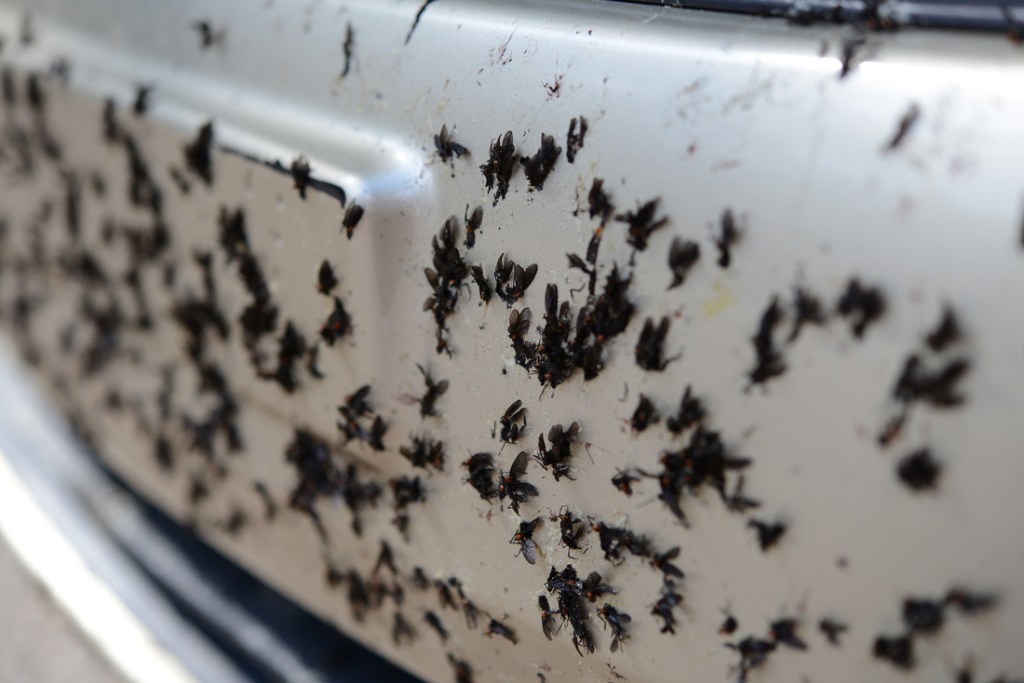
Love bugs can leave a sticky mess on windshields and paint, especially if left baking in the sun. Here are some practical tips:
- Wax your car before swarm season. The smoother surface makes cleanup easier.
- Drive cautiously—or not at all—during peak swarm times, usually morning and late afternoon.
- Quick cleanup matters: water and mild soap will do. Ain’t no need for fancy sprays.
- Consider bug screens or mesh covers for parked vehicles.
- Front-end guards or bug deflectors help reduce splatter on hoods and windshields.
In some years, especially after cool, wet summers, lovebugs show up way farther north than usual—even northwest Louisiana. While they don’t bite, their acidic guts can damage car paint and, in large clouds, even block radiators. Over the past 15 years, they’ve gradually moved north and east along the Gulf States, appearing as far as South Carolina.

Love bugs are part of Louisiana life. They’re messy, sure, but they’re also a reminder of the cycles all around us—tiny creatures that quietly keep the soil healthy and the rhythms of nature that don’t wait for our schedules.
About that title: For those not from around here, it nods to Ray Stevens’ 1974 novelty hit “The Streak.” The husband keeps yelling, “Don’t look, Ethel!” as streakers run through town—he’s always too late. Just like you might be too late dodging lovebugs on the highway.
That’s it for now. Thanks for showing up. It matters.

Post Script: If you’ve got a love bug horror story to share, please do!
References Used in the Article:
- “I heard that UF was responsible for releasing the Lovebug. Is that true?” May 6, 2014. https://blogs.ifas.ufl.edu/entnemdept/2014/05/06/uf-lovebug-myth/
- Treasure Coast Palm. “Do lovebugs have a purpose, beyond annoying us all twice a year?” May 7, 2019. https://www.tcpalm.com/story/news/2019/05/07/what-purwhat-is-the-purpose-of-love-bugs-pose-love-bugs/1128398001/
- University of Florida IFAS Extension. “Lovebug, Plecia nearctica.” https://entnemdept.ufl.edu/creatures/misc/lovebug.htm
- Texas A&M AgriLife Extension. “Lovebugs: Facts and Tips for Avoiding the Mess.” https://agrilifeextension.tamu.edu/library/gardening/lovebugs-facts-and-tips-for-avoiding-the-mess/
- LSU AgCenter. “Lovebugs: Seasonal Swarming Insects in Louisiana.” https://www.lsuagcenter.com/articles/page1644256428232
- Minden Press-Herald. “Loads of love bugs in Northwest Louisiana. September 5, 2017. Associated Press. “Loads of lovebugs in northwest Louisiana.” Sep 5, 2017.
- Treasure Coast Palm. “Do lovebugs have a purpose, beyond annoying us all twice a year?” May 7, 2019. https://www.tcpalm.com/story/news/2019/05/07/what-purwhat-is-the-purpose-of-love-bugs-pose-love-bugs/1128398001/
 Veni. Vidi. Scripsi.