
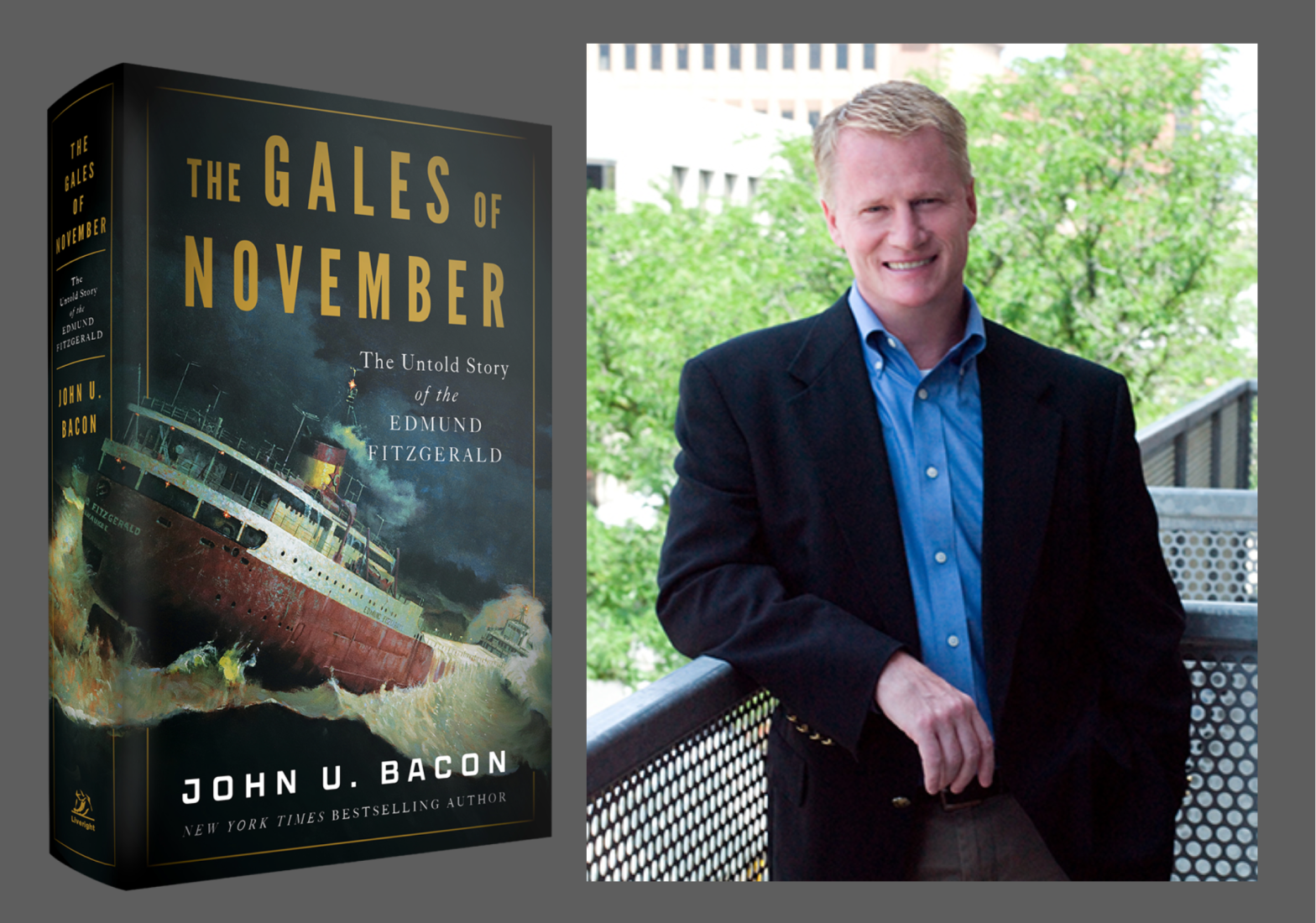
When I was writing a commemorative post about the anniversary of the Edmund Fitzgerald, I stumbled across a new book on the subject. That put me in a bit of a quandary: since retiring, I’ve been trying to downsize my personal library from four six-foot bookcases to two. Ouch! If you’re a bookworm, you know that kind of ache.
Well, all that to say: John U. Bacon’s The Gales of November: The Untold Story of the Edmund Fitzgerald is probably the next book I’ll add to my shelves.
But I’m only twenty pages in, so this isn’t a full-on review. I’ll write a longer reflection once I’ve traveled the whole route with Bacon. For now, though, the early excitement demanded its own small flare sent up into the night sky. Call it a reader’s SOS—Share Or Suffocate.
Early in the book, Bacon gives readers a sense of the Great Lakes’ true scale:
“Few Americans understand just how great the Great Lakes really are. Unlike the Grand Canyon, the majesty of the Great Lakes isn’t immediately apparent. The lakes don’t open before you in a single, sweeping view. Their immensity fully unfolds only for those who navigate their waters.
How big are they? In terms of volume, these five lakes hold more than 80 percent of North America’s freshwater, and more than 20 percent of the world’s. If you could empty the Great Lakes over North and South America, you would flood the land in a foot of standing water. [emphasis mine]
Another perspective: If you stand on any of the Great Lakes’ shores and look across, at most points it’s impossible to see the far shore. This has nothing to do with atmospheric visibility; they’re simply so vast that the earth’s curvature renders the port cities across the water invisible even on the clearest days. When you’re sailing in the middle of Lake Superior, Lake Michigan, or Lake Huron, you cannot see either shore. You might as well be bobbing aimlessly in the middle of an ocean, lost as can be—which must be how many Great Lakes’ victims felt before their boats disappeared.”
John U. Bacon is a New York Times bestselling writer and longtime journalist whose three decades of work as author, speaker, instructor, commentator, and even high school hockey coach have earned national recognition across multiple fields.
Bacon’s eye for detail, and his gift for keeping history tied to real people, has already sparked a handful of writing ideas for me. I meant to borrow the book from the local library briefly, but I suspect it’s headed for my own shelf soon. There’s something here I want to linger with.
A longer piece will come once I’ve traveled farther in the story. For now, these early pages felt worth sharing an invitation to attention, and maybe a little awe.
That’s it for now. Thanks for showing up. It matters.

 Veni. Vidi. Scripsi.