My Bible reading plan fell apart last year, somewhere around Solomon’s temple, because life got in the way and attention wandered. And that’s okay.
What if the hard part of reading Scripture isn’t maintaining perfect consistency or mastering ancient languages? What if the transforming, sustaining, wisdom-building work isn’t mine to carry at all? What if my only job is to show up and let God do His?
The turn of the calendar brings a natural pause, a space to breathe, reflect, and think about the year ahead. It invites me to spend regular time with God in His Word, which may be my most important task and my deepest need.
Throughout this piece, I reference Scripture. If you’d like to look up these passages yourself, you’ll find a list of references at the end of this article. If you’re new to finding verses, any Bible’s table of contents will guide you, or you can search the reference online.
Resolutions vs. Direction
I used to begin a new year with resolutions or lists of goals, as if willpower alone could shape the months ahead. I have rarely made it past mid-January with resolutions, and I cannot remember the last time I knew someone who did. Maybe you are different that way.
Scripture reminds me that human effort, while necessary, is incomplete without the guiding light of God’s Word. Beginning with the text brings clarity in the fog and direction when I feel lost. That’s not theory. It’s what carried me through this past year.
When Life Intervened
The challenge is real. Distractions are many, and attention is fragile. I miss a day here and there. Several days, even. This past year, I didn’t make it out of 1 Kings before life intervened.
And life did intervene. Some very difficult things happened this past year for people I love. Scary things. The kind of situations that arrived without warning, where fear whispers that the worst might happen, where you find yourself waiting and not knowing what comes next. The kind that could have driven me into a dark place of worry and doubt.
I’m sure I’m not the only one who’s faced that kind of year.
But here’s what I noticed afterward: in those hallways, driving those highways, and in those sleepless nights, I was carried on a confidence and rest that did not come from the world. Phrases I’d read months earlier surfaced when I needed them. Not because I’d memorized them, but because they’d taken root somewhere deeper. Scripture had literally become a lamp when darkness closed in, exactly as it promised to be. It gave me hope when I needed strength to keep going, not as a nice sentiment but as an anchor when everything felt uncertain.
That authentic confidence came from my faith, grown quietly through the months I’d spent in those pages, even imperfectly. I don’t chalk that up to coincidence.
Let me be honest: reading the Word isn’t a magical elixir. I’ve been through tough times, dark times, times I doubted God’s presence. And by that I mean “prayers bouncing off the inside of my skull” doubted. And I have waited beyond all endurable stretch of patience; weeks and weeks of weeks. But my testimony here is that He brought me through it, and by that taught me. I can stand on this promise: when I belong to Him, He never leaves me.
Never.
Ever.
Despite what my mind is shouting, what my senses are telling me. The Word doesn’t prevent hard things. It equipped me to walk through them. And in a world trying so desperately to avoid pain, that is indeed good news.
And I didn’t have to understand everything I read for it to do its work. I just had to open the book.
Why We Read
Scripture itself tells us why we need it. It guides us like a lamp in the dark. It prepares us for the work ahead. It offers us hope when we need strength to keep going. It gives us wisdom for building our lives on solid ground and shows us God’s love most clearly in Christ. These aren’t just ideas. They become real as we engage, even imperfectly.
Reading Scripture is about engagement, not performance. It is not about checking a box or showing what you know. It is about listening, understanding, and responding. Each passage opens a window where we catch a glimpse of God’s plan.
But for me, it is not about the destination. It is about the journey.
Practical Approaches to Reading
Who am I to suggest you read the Bible? Just some guy who writes a blog. But I was once someone who had no idea the Bible could actually be read and understood in a way that drew me closer to my Savior. If that’s where you are, I get it.
The possibilities are simple and endless. Many Bibles include reading plans, so check your table of contents. Sites like BibleGateway.com, BlueLetterBible.com, and Biblehub.com. offer free plans. Apps like YouVersion provide daily reminders and guided reading right on your phone.
If an old approach feels intimidating or stale, try a new one. Jesus spoke of new wineskins for new wine. God meets us where we are: reading on your phone at lunch, starting with the Gospels, or listening to audio while folding laundry. The goal is simply to get into the Word in a way that fits your life.
Consistency matters more than quantity. Presence matters more than perfection. Over time, steady attention builds wisdom and strength.
Finding a Translation That Works for You
If old language or unfamiliar names make the Bible feel distant, try a modern translation. The Holy Spirit meets us in words we can hear clearly.
Popular options include the New International Version (NIV), the English Standard Version (ESV), the King James Version (KJV), the New Living Translation (NLT), and the Christian Standard Bible (CSB). You can compare them side by side for free on several sites mentioned above. Click here to see an example of that, using John 3:16.
The King James Version is terrific for its beautiful language. Jesus spoke Aramaic, and the New Testament was originally written in everyday Greek, so modern translations aim to capture that same accessible feel in our own language today. That said, the KJV’s older wording often makes it very difficult for me to really grasp Paul’s more complex spiritual arguments in the epistles. So I’ve added other translations to my library to help me understand those passages more clearly. I read the New Living Translation (NLT) for twenty years and have recently added the Christian Standard Bible (CSB) and the English Standard Version (ESV) for fresh perspective. (This topic is close to my heart, so I’m planning a deeper reflection on translations later this year.)
Modern translations draw from discoveries like the Dead Sea Scrolls, helping us grasp the original meaning more accurately in our own language—without dumbing anything down.
Study Bibles add helpful notes like a wise friend in the margins, but a simple Bible and an open heart are all you truly need.
Jesus quoted Hosea to say God desires mercy, not sacrifice. The same spirit applies here: thoughtful attention over hurried completion. I’m learning to take my time.
Trust the Process
Here’s what I’ve learned: once we surrender our hearts to God and open His Word, the Holy Spirit does the real work. My job isn’t to decode ancient languages or master complicated theology. My job is to read honestly and listen.
The Word is alive and active. It works in everyone who engages with it. For believers, it brings life and wisdom. If you’re still searching, it can open your eyes and draw you closer to God. The Spirit uses Scripture to do what God intends, meeting each person right where they are.
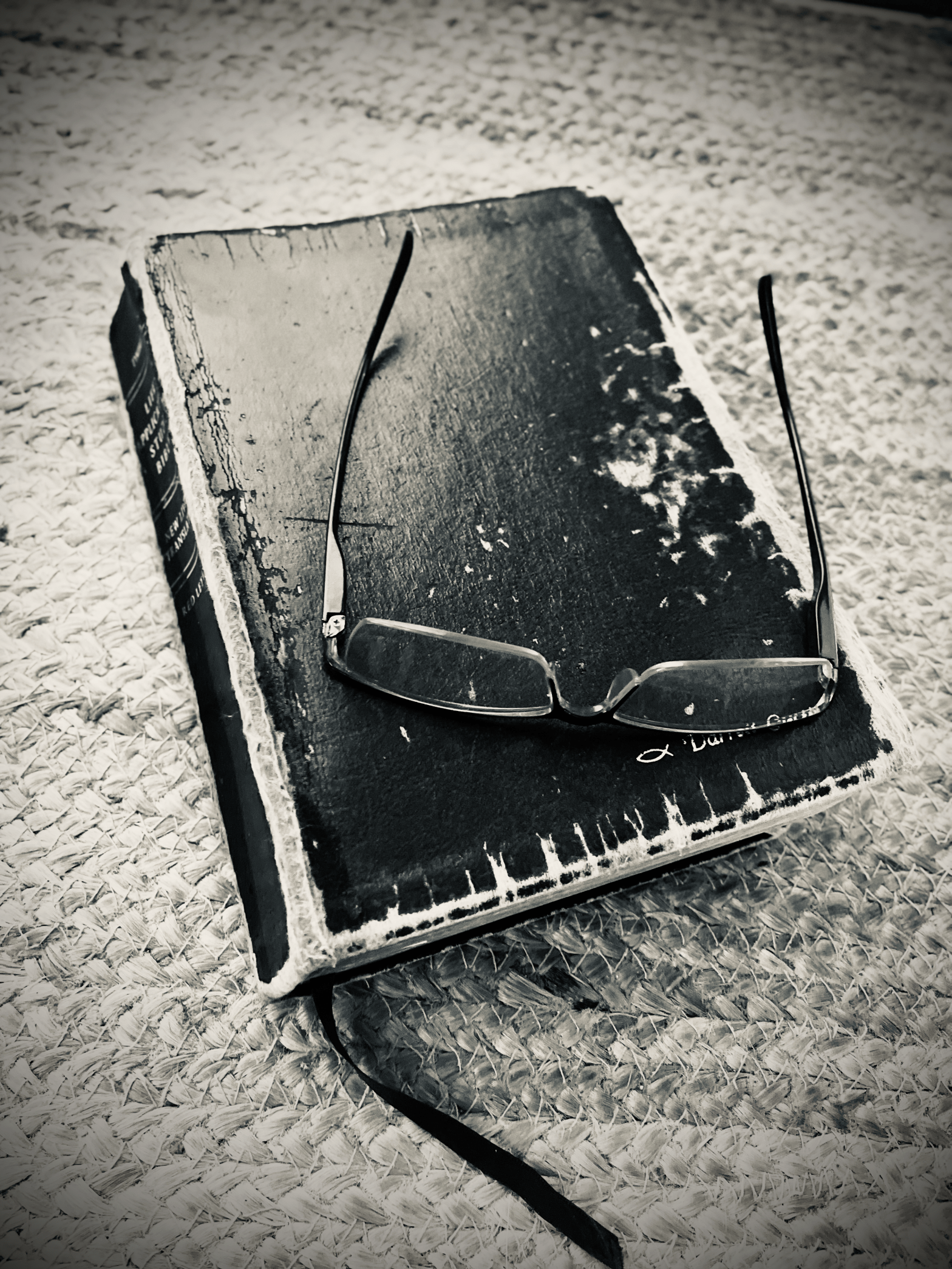
Whether you’re reading the King James Bible your grandmother gave you or a modern translation on your phone, learn to trust the process. To trust the Spirit. To trust that opening the book is enough.
Linger in the Word
As we step into this year, I want to linger in the text, pay attention to its rhythms and flow, and allow God’s Word to frame the year before me.
Maybe the hard part isn’t mine after all. The transforming, the sustaining, the teaching: that’s the Spirit’s work. Mine is simply to open the book and let Him do what only He can do. Starting with Scripture invites us to steady our pace, sharpen our vision, and embrace the journey with clarity, patience, and grace.
I hope you’ll join me in this.
That’s it for now. Thanks for showing up. It matters.

Editorial Note: This week begins our January cadence. Each primary reflection will focus on a single theme, with secondary essays appearing only when needed. The goal is to create space for thoughtful reading and reflection rather than overwhelm the calendar. This week, the journey begins with Scripture, not as obligation, but as invitation.
Scripture References:
Psalm 119:105, 2 Timothy 3:16-17, Romans 15:4, Matthew 7:24, John 3:16, Romans 5:6, Hebrews 4:12, Matthew 9:13, Matthew 12:7
 Veni. Vidi. Scripsi.