
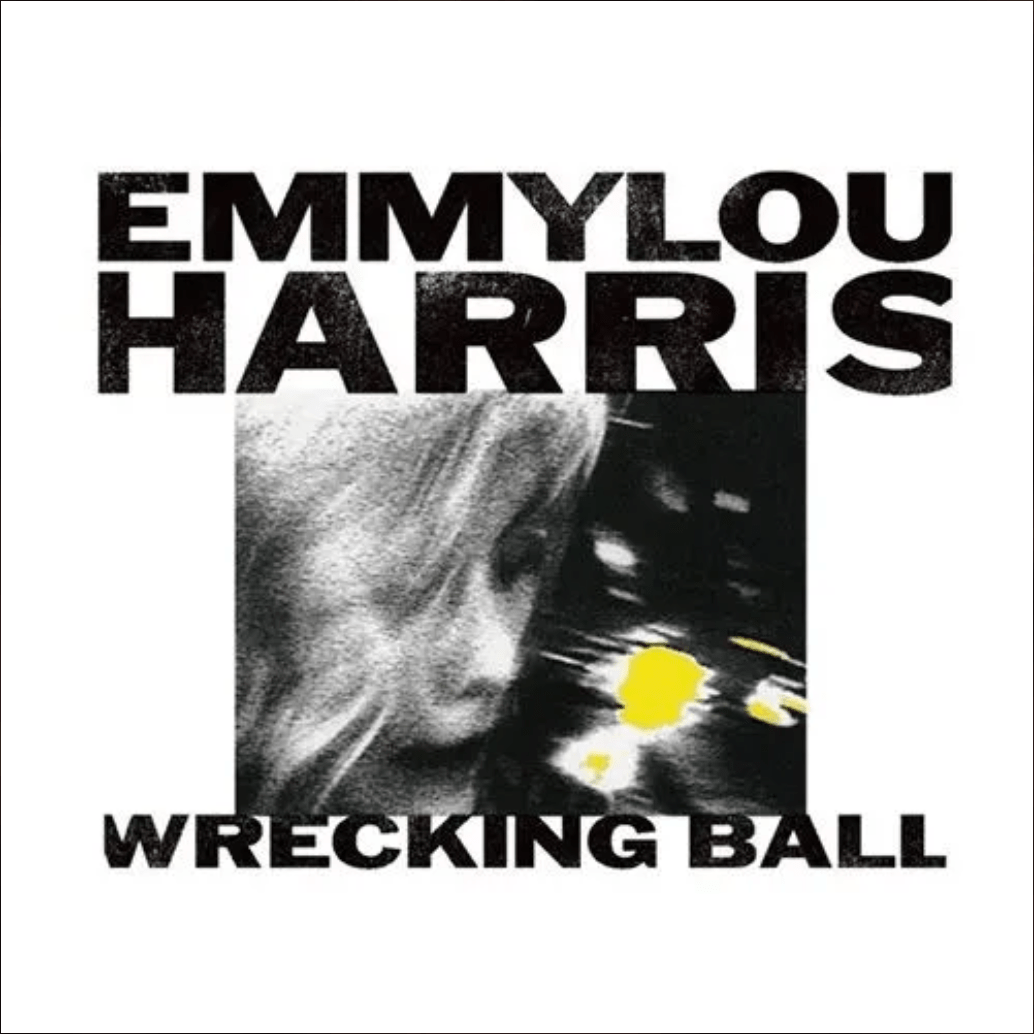
I came across the Wrecking Ball CD in the late 1990s, pulling it from the racks at the Vernon Parish Public Library in Central Louisiana. The cover alone — a high-contrast black-and-white close-up of Emmylou’s face blurred and streaked as though dissolving into shadow or motion, pierced by a single vivid yellow glow that cuts through the darkness like a fleeting light in the haze — caught my eye.
It suggests a world that is mostly dark and uncertain, with moments of intense brightness forcing their way in. That tension — between shadow and light, stillness and disruption — is exactly what the album sounds like emotionally.
Before this, Emmylou had built her name on country rock’s golden edge — the Gram Parsons years, the harmonies that defined a genre, albums like Pieces of the Sky (1975) that felt like they’d always existed. Hers was a voice for tradition, clarifying it, honoring it.
Wrecking Ball hit different. Released September 26, 1995, it felt like she’d stepped into a new room altogether, one Daniel Lanois built with reverb, space, and a rock undercurrent courtesy of Larry Mullen Jr. on percussion for nearly every track. Her voice dipped lower, smokier, carrying a weight that spoke of searching and settling in ways that stayed with me long after the last track faded.
In February 2025, the album joined the Canadian GRAMMY Hall of Fame — fitting recognition for a record that marked a turning point. Emmylou called it just that in interviews: a door opening when others were closing on country radio. At the May 16, 2025 gala she performed “May This Be Love” with Daniel Lanois, joined by Brian Blade on drums — a gentle revisiting that reminded everyone how those songs still hold power.
Red Dirt Girl (2000) — another favorite of mine — feels like a true companion piece: same atmospheric pull, more of her own songs, produced with similar depth by Malcolm Burn. I’ll write more on that one down the line. It picks up where Wrecking Ball left off, carrying the same sense of quiet searching.
Track-by-Track: Listening with Open Ears
What draws me back to these songs isn’t flash. It’s the way they sit with you, like old friends sharing hard truths over coffee. Here’s a walk through them — the story each song tells, then the sound and how Emmylou carries it. I’ve dropped in audio so you can give an ear to them if you want to.
- Where Will I Be (Daniel Lanois) A wanderer moves through broken places: cracked streets, war fields, brief loves, asking where he’ll stand when judgment comes. The speaker feels like any of us at our most honest, facing the unknown with a poet’s ache. Opens with shimmering guitar and Mullen’s drums tumbling like distant thunder. Emmylou’s voice floats above it all, light yet weighted, harmonies wrapping around like prayer.
- Goodbye (Steve Earle) A man looks back on a love gone quiet, nights in Mexico blurred by time and regret — no clear farewell, just lingering ache like smoke that won’t clear. The speaker owns his part without excuses. Gentle folk-rock sway, Earle on acoustic. Her delivery is soft, almost whispered on the refrain, carrying sorrow without raising the voice.
- All My Tears (Julie Miller) Someone departing this life comforts those left behind: wounds healed, tears washed in light beyond the sun and moon. The speaker speaks with steady assurance, pointing to something greater. Hypnotic pulse, synth and gentle drums. Emmylou’s lower register glows with conviction, warm and unforced.
- Wrecking Ball (Neil Young) Life laid bare, inviting a dance amid ruin: meet me there, pretty and white, before it all comes down. The speaker meets destruction with open-hearted courage. Slow seduction, bass deep, Young’s harmonica weaving in. Her voice smoky, anticipatory, finding beauty in the fall.
- Goin’ Back to Harlan (Anna McGarrigle) Memory returns to childhood woods and rivers, nursery rhymes giving way to old ballads that mend a broken heart. The speaker longs for innocence while facing time’s toll. Dulcimer and organ in a loose folk reel. Wistful, bowed vocals that bounce then settle into quiet reflection. (“Harlan,” by the way, is Harlan, Kentucky.)
- Deeper Well (David Olney, Daniel Lanois, Emmylou Harris) A lifelong hunt for meaning: love, money, faith, rage, ending in dry rivers and addiction’s hold, reaching for holier water. The speaker confesses openly, no varnish. Tension builds with electric edges and heartbeat drums. Emmylou digs in, throaty and urgent, soaring where the thirst breaks through.
- Every Grain of Sand (Bob Dylan) In despair’s depths the speaker sees order: trembling leaves, falling sparrows, God’s hand in every detail. Humbled, he breaks chains and steps forward. Swaying organ and subtle kit. Her cracked, clear delivery turns poetry into something almost confessional.
- Sweet Old World (Lucinda Williams) Mourning what the departed lost: kisses, trains, heartbeats in rhythm with another. The speaker asks gently: Didn’t you know you were worth it? Lullaby-slow storm of reverb. Smoky croon that holds the grief without overwhelming.
- May This Be Love (Jimi Hendrix, with Daniel Lanois) Surrender to a waterfall’s peace: rainbows, nothing wrong, falling forever. The speaker rests in mystery’s embrace. Aquatic haze, rolling toms. Light, mystical duet harmonies that feel weightless. (A Jimi Hendrix cover)
- Orphan Girl (Gillian Welch) Alone on the highway, no earthly kin, but promised family at God’s table. The speaker waits with patient faith. Woodsy and spare, swelling gently. Intimate and prayerful, building to quiet triumph.
- Blackhawk (Daniel Lanois) Working lives grind on: bookstore shifts, steel mills, while old love and small-town heroes fade into memory. The speaker holds the ache tenderly. Mid-tempo heat, slide guitar like furnace glow. Lower tones world-weary yet kind.
- Waltz Across Texas Tonight (Rodney Crowell, Emmylou Harris) Amid cold roads and ghosts, offering a steady hand for one last dance under stars. The speaker chooses hope in the ordinary. Closes with swirling piano and slide. Light, firm vocals anchoring the farewell.
Atmospheric Evocation: The Spell Woven in Sound
The cover’s blurred face streaked in shadow with that piercing yellow glow hints at the haze within, but it’s the way Emmylou and Daniel Lanois craft the air around these songs that pulls you in deeper, like stepping into a piney wood at dusk where every rustle carries meaning. The evocation lives in the listening: the slow unfurling of reverb that hangs like fog over a bayou, drawing out the quiet spaces between notes until they breathe on their own. Lanois, with his knack for breaking studio rules, set up in an old Victorian mansion — no walls between the players, just one room where musicians like Mullen on those tribal-leaning drums and Brian Blade adding subtle pulses could feed off each other. He looped guitars into distant echoes, slurred vocals into fragile whispers, placed bass and percussion right at the heart like a steady pulse under skin, letting the sound swell and wilt without rush.
And Emmylou’s voice — ah, that’s the thread that weaves it all. She stepped away from the high-lonesome clarity of her earlier days, dipping into lower, smokier tones that carry a lived-in weight, inspired by the raw collaboration around her. Lanois coaxed that out, suggesting shifts like turning Dylan’s “Every Grain of Sand” into a swaying rhythm, her delivery cracking open like dawn light through branches, clear yet vulnerable above the squalling guitars below. It’s a spell of sorts, this ominous glow: humid drums humming, synthesizers dappling like fireflies, her voice positioned front and center to soar or simmer as the moment calls. In tracks like “Deeper Well” the electric edges build a thirst you can feel, her urgency rising throaty and real, pointing to a grace that shows up unbidden in the search. Or “May This Be Love,” cresting euphoric in watery haze, harmonies weightless as surrender. It’s quiet work in ordinary craft, transforming covers into something timeless, where loss and hope entwine without force, just the steady hand of sound guiding you through.
That’s it for now. Thanks for showing up. It matters.

 Veni. Vidi. Scripsi.