
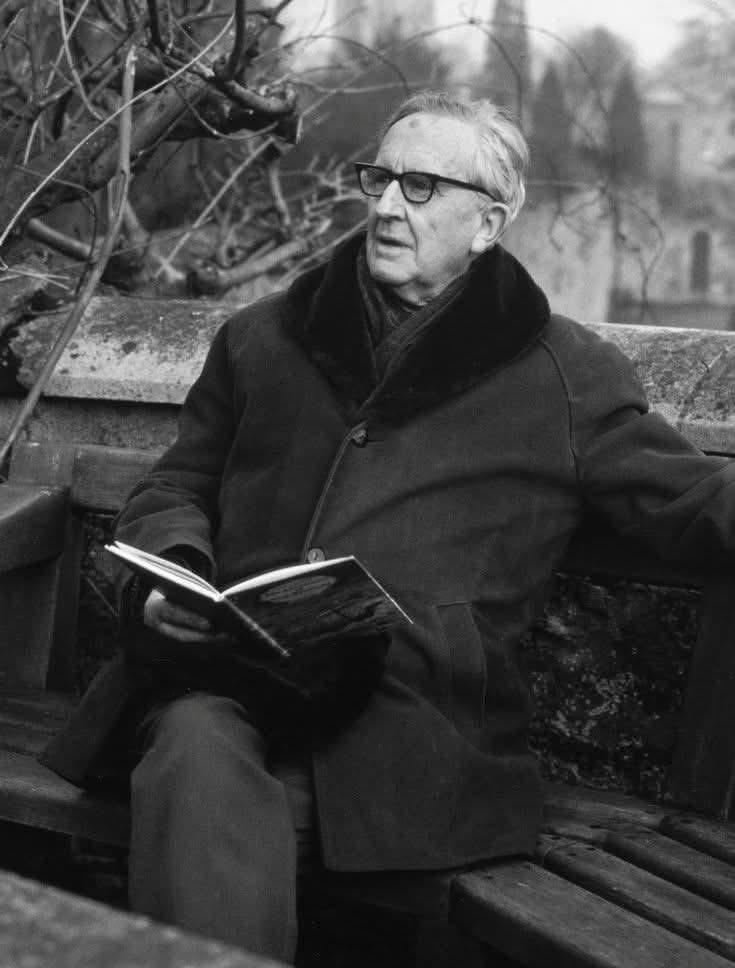
When the flame was kindled on January 3, 1892, a mind was born that would illuminate not just Middle-earth but the quiet corners of imagination itself. J. R. R. Tolkien’s life was marked by a devotion to language, story, and the natural world—a devotion most intimately visible in one of his smallest, yet most curious, works: Leaf by Niggle.

Published in The Dublin Review on January 1, 1945, this tale is as eccentric as it is charming. At first glance, it tells the story of Niggle, a painter who labors endlessly on a single leaf in a great mural of a forest, only to be constantly distracted by obligations and neighborly needs. The plot is simple, but the execution is exquisite: Tolkien gives life to leaves, trees, and a world of quiet detail with a linguistic precision that feels both immediate and eternal. Reading it, one is struck by the poetic vitality of a world imagined as “living things,” where art and life are inseparable.

Many readers have approached Leaf by Niggle as allegory, and yet, as we know, Tolkien disliked allegory in favor of applicability. Still, the story speaks, subtly and hauntingly, to the human journey, to the inevitability of death, and to the creative impulse that drives us forward even when the world seems to demand everything else from us. In his story, Niggle’s work is never complete; the brush may rest, but the imagination keeps moving, and in that motion lies a kind of grace.
Interestingly, Tolkien once remarked that the story came to him “virtually” complete one morning in 1939, just before the storm of the Second World War. He wrote it out “almost in a sitting,” born of a morning’s reflection on his love of trees, his anxieties, and the fear that The Lord of the Rings might never reach its end (Organ, 2018). Letters preserved in Carpenter’s biography reveal this tension and delight—Letter 98 to Stanley Unwin, March 18, 1945, and Letter 199 to Caroline Everett, June 24, 1957—underscoring Tolkien’s remarkable ability to channel a lifetime of thought and feeling into a few pages of story.
For me, encountering Leaf by Niggle some twenty years ago offered a glimpse of Tolkien beyond the sweeping landscapes and epic battles. Here was a writer whose imagination was at once disciplined and untamed, whose affection for the minutiae of creation revealed as much about the artist as it did the art. Niggle’s forest is a mirror of Tolkien himself: meticulous, alive, and tenderly aware that some works remain forever unfinished, yet are all the more beautiful for it.
Publishing this reflection today, January 3, feels fitting. We mark the birthday of Tolkien, when the flame of his imagination was kindled, not with grand celebration but with quiet recognition. In the gentle eccentricity of Niggle, in the love of trees and leaves, we find the human impulse to create, to persist, and to leave traces of beauty in the world, however incomplete.
That’s it for now. Thanks for showing up. It matters.

If you’ve half an hour to listen to a charming dramatization of “Leaf by Niggle,” have a listen to this:
Editorial Note: This January, our publishing cadence will reflect a rhythm of reflection and commemoration. Rather than crowding multiple pieces on similar themes, each week will carry one primary meditation, with a secondary essay when appropriate, allowing space for thoughtfulness and rest. Today’s reflection marks the start of this measured approach.
Sources & Notes
Tolkien, J. R. R. “Leaf by Niggle.” The Dublin Review, January 1945.
Tolkien, J. R. R. The Letters of J. R. R. Tolkien. Edited by Humphrey Carpenter with Christopher Tolkien. London: HarperCollins, 2023. Letters 98, 131, 199.
Organ, Michael. “Tolkien’s Surrealistic Pillow: Leaf by Niggle.” Journal of Tolkien Research 5, no. 1 (2018): Article 7.
 Veni. Vidi. Scripsi.
One thought on “Leaf by Niggle: The Work We Leave Unfinished”
Comments are closed.